Learning Disability Today
Blue Sky Offices Shoreham
25 Cecil Pashley Way
Shoreham-by-Sea
West Sussex
BN43 5FF
United Kingdom
T: 01273 434943
Contacts
Alison Bloomer
Managing Editor
[email protected]
[email protected]

As people with a learning disability grow older, they experience a steep decline in available services and opportunities. Inclusive technology offers an opportunity to reverse that trend by providing consistent and accessible support.
Support for people with a learning disability in the UK is under immense and growing pressure. Four in five schools report that they lack the funding to meet pupils’ additional needs, while adult social care services remain overstretched and under-resourced.
The impact is clear: families, teachers, and care providers are being left to navigate increasingly complex challenges with limited resources. In the face of these strains, we urgently need to rethink how we support individuals with a learning disability through approaches that are person-centred, dignified, and sustainable.
One key part of the solution is already within reach: inclusive technology. When thoughtfully designed and appropriately deployed, it can empower people of all ages and abilities to connect, learn and express themselves.
Learning disabilities do not disappear with age, yet the support often does. After leaving school, many individuals experience a steep decline in available services and opportunities. Inclusive technology offers a chance to reverse that trend by creating consistent, accessible support that extends from education into adult care and community life.
At Northgate School in Edgware, sensory-interactive tools are enabling students to engage in learning on their own terms. Light-based games and activities offer alternative ways to communicate, build confidence, and participate, especially for those who find traditional classrooms difficult learning environments. This impact continues into adult care settings.
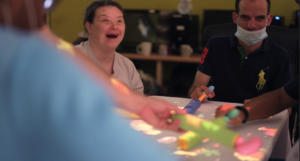 At Southmead Hospital , part of North Bristol NHS Trust, the Happiness Programme is being used across four wards to help patients with cognitive disabilities engage in therapy and daily activities.
Sophie Wheeler from North Bristol NHS Trust explains, “The Happiness Programme has been an invaluable asset to our teams. It not only enhances patient focus and engagement during therapy, but we’ve also observed a significant reduction in falls as a result. We have four units across the hospital to help our patients with cognitive disabilities, and patients will sometimes refuse to share because they love it so much!”.
Beyond this, technologies such as voice-assisted devices are supporting communication for those with limited speech, while accessible digital tools help individuals build skills at their own pace. These are not speculative solutions; they are already making a tangible difference in people’s lives.
While measurable outcomes, such as reduced falls or improved literacy, are crucial, some of the most powerful impacts are less easily quantified —a moment of connection, a burst of laughter, or a new way to express a thought. For people with a learning disability, particularly those facing barriers to communication or movement, these moments can be life-changing.
Technology doesn’t replace human care, but it expands the ways in which that care can be delivered. It provides professionals, families, and individuals with more tools to foster creativity, engagement, and emotional wellbeing.
Inclusive design should not be confined to schools or care settings. Across the UK, libraries, community centres, and day services are beginning to explore how sensory technology can make public spaces more accessible and welcoming for people with learning disabilities.
These are often the few spaces where people can gather, learn, or relax outside of structured care and yet they’re rarely designed with neurodiversity in mind, and too often without input from those with lived experience. This doesn’t require large capital investments or overhauls.
With the right approach and modest investment, any environment, from a city library to a rural day centre, can be transformed into a more inclusive space.
There are now more than 1.5 million people living with a learning disability in the UK, and the number is rising. Meanwhile, the workforce supporting them is increasingly stretched. Inclusive technology should not be a luxury; it is a scalable, cost-effective, and proven tool that can improve outcomes across education, care, and everyday life.
It enables staff to accomplish more with limited time and resources. It gives individuals more autonomy and dignity. And it creates continuity of support across a person’s entire life journey.
Local authorities, education leaders, and commissioners must recognise what already works and provide the resources to scale it. In a time of unprecedented pressure on services, embracing inclusive technology offers a hopeful, pragmatic path forward.
By John Ramsay, Founder and Managing Director, Social-Ability


