Learning Disability Today
Blue Sky Offices Shoreham
25 Cecil Pashley Way
Shoreham-by-Sea
West Sussex
BN43 5FF
United Kingdom
T: 01273 434943
Contacts
Alison Bloomer
Managing Editor
[email protected]
[email protected]

The latest Learning from Lives and Deaths: People with a Learning Disability and Autistic People (LeDeR) report was published without fanfare online this week after nearly a year’s delay. This time, the findings provoked more sadness than shock. The outrage felt more defeated.
The promised Ministerial Statement was delivered by Stephen Kinnock MP, Minister of State for Care, who stated we must continue to “learn about what we need to do to address the clear health inequalities that continue to exist in our health and social care system”.
He added that action was needed to prevent avoidable deaths and to understand how services can be improved.
Eight years into the programme, however, headline figures show that in 2023, adults with a learning disability die on average 19.5 years earlier than the general population, with nearly 60% who had a LeDeR review dying before the age of 65.
It also found that although avoidable deaths have declined since 2021, the rate for adults with a learning disability who died in 2023 from a preventable cause is still nearly twice that of the general population.
What does ‘double the rate of avoidable deaths’ look like outside a data report? The Foreword from the Staying Alive and Well Group, made up of self-advocates, does a great job of illustrating the horror and unnecessary tragedy of this sentence.
They said, “There are lots of people who should be here. They should have been at birthdays, graduations, weddings, and funerals… we don’t want to be an empty chair at Christmas. We do not want to be just a memory or a photograph on the wall.”
The fact that these deaths still occur in such large numbers shows that either we are still far from understanding the actions that Kinnock and his predecessors keep saying need to be addressed, or not enough is being done to achieve them. Complacency or incompetence. Which feels worse?
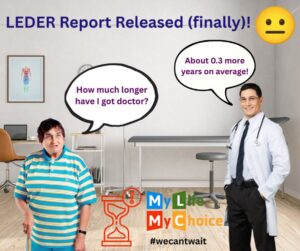
It also raises the question of what other area of life in England would allow a human rights scandal of this scale to occur and continue happening?
The rate for adults with a learning disability who died in 2023 is still nearly double the rate compared to the general population.
The LeDeR programme was established in May 2015 to support local areas across England to examine the deaths of all people with learning disabilities aged four and over through a three-stage review process. It begins with an initial inquiry into a death, and where lessons can be learnt, multi-agency reviews and action plans should then follow.
The University of Bristol was commissioned to deliver the programme for its first five years (2015-2020) by the Healthcare Quality Improvement Partnership (HQIP) on behalf of NHS England. It was then directly delivered by NHS England from 2020 to 2021. It had two aims:
In May 2021, the University of Bristol’s involvement in the programme came to a planned end. The scheduled end of NHS England’s contract with the University of Bristol in May 2021 provided an opportunity for NHS England to reflect on what had gone well with LeDeR and to identify areas of the programme that needed improvement.
A newly revised LeDeR policy was published by NHS England in 2021, incorporating a refreshed review process that included reviews of the deaths of people with autism.
This is why the latest report only compares the results with those who died in 2021 and 2022, which does not truly provide the best indication of changes over the entire programme period.
The concept of preventable deaths in people with a learning disability is not new. We have been discussing them for a considerable amount of time. The 2010-13 Confidential Inquiry into Premature Deaths of People with Learning Disabilities found that nearly a quarter of people with learning disabilities were younger than 50 years when they died, with women dying on average at a younger age than men.
The same contributory factors outlined in reports dating as far back as 2007 are flagged up in the latest LeDeR data and include problematic or unsafe hospital discharges, diagnostic overshadowing, incomplete learning disability registers held by GPs, and a lack of application of the Mental Capacity Act.
The patchy provision of specialist learning disability liaison nurses in hospitals is another factor, as is the lack of families feeling listened to or their concerns being acted upon, and the failure to consider the need for ‘reasonable adjustments’ to existing policies and processes for people with learning disabilities.
Other variables impacting preventable deaths identified by the LeDeR reports are:
The report said that of the 2,412 adults with a learning disability who died in 2023, 75.5% had a Do Not Attempt Cardiopulmonary Resuscitation (DNACPR) decision in place at the time of death, of which 277 were aged under 50 years. This compares to 72.1% in 2022 and 72.5% in 2021.
In 2023, 11 of the DNACPRs were completed but not followed correctly, 145 were incorrectly completed, and six were neither completed nor followed correctly. That’s an unforgivable number of people.
Another potential factor highlighted was social care packages. One in four of the 2023 reviews did not have a care package that met their needs, suggesting that a significant proportion of the adults who died did not have adequate support.
In addition, the report found 37% of deaths of people with learning disabilities or autism involved some form of delay in care or treatment. In comparison, 28% reported instances where diagnosis and treatment guidelines were not met.
In terms of reasonable adjustments, 27.3% reported needing at least one adjustment that was not provided. On top of this, the Mental Capacity Act (MCA) was only correctly followed for 68.2% of adults with a learning disability who died and had a capacity assessment in place.
Once again, there are also concerns about disparities across racial and ethnic groups and stark differences across socioeconomic groups. From June 2021 to December 2023, 43.1% of deaths reviewed by LeDeR among adults with a learning disability, where ethnic group was available, were classified as avoidable.
There was also a chapter on autistic people, and the data continues to show relatively high numbers of deaths by suicide, misadventure, or accident in autistic adults whose deaths were reported to LeDeR. However, the researcher did say that they had to be cautious in their interpretations due to the underreporting of deaths of autistic adults to LeDeR. In addition, deaths by suicide are routinely investigated by a coroner and, therefore, may be more likely to be reported to LeDeR than other causes of death.
A further analysis of people with a severe or profound learning disability (PMLD) found that they are more likely to die at a younger age than people with a mild or moderate learning disability.
They are also more likely to experience an avoidable death in comparison to the general population. Just over one-third of deaths of those with a severe or profound learning disability were classed as avoidable. Within this, people with PMLD were more likely to die of a treatable cause than those with a mild or moderate learning disability. This might suggest that people with PMLD are at risk of later diagnosis and treatment or receive less effective care.
The report itself acknowledges that a limitation is that notifications of deaths to LeDeR are not compulsory, and data on deaths may therefore be incomplete.
In addition, in the 2023 report, Medical Certificate of Cause of Death (MCCD) data were only available for 1,887 (78.2%) of the 2,412 completed reviews for adults with a learning disability who died in 2023.
Reasons for the MCCD not being available at the time of review include cases where a coroner’s input was required, cases involving a police investigation, or situations where the cause of death needed further investigation.
The authors also note that due to unforeseen pressures on the NHS, there have been somewhat fewer completed reviews than anticipated, which has particularly affected reviews during the latter part of 2023.
This raises concerns about the validity of the results and whether we are seeing the complete picture. It also raises the question of whether the costs that run into millions associated with the LeDeR would be better invested in helping people with learning disabilities lead healthier lives.
For example, would resources be better used to train and employ specialist learning disability nurses, who are ideally placed to help people with learning disabilities access mainstream health services?
Or perhaps investment in health technology that allows people with a learning disability or their caregivers to check, record, and question their key health needs and data.
Even using resources to encourage improved uptake of vaccination programmes and effective management of conditions such as epilepsy and mental health problems would be more cost-effective for the NHS and actually deliver some essential improvements.
We will be publishing the results of our health campaign next week, which will review the hundreds of responses we have had to the question of how the sector can work together to end the premature mortality of people with learning disabilities.
Preventative and proactive healthcare is long overdue. It shouldn’t be this hard to achieve, and at the very least, the new NHS 10-year plan should prioritise learning disabilities more.
We can’t undo what has happened in the past or the attempts to cover up bad practices. Nor is there a single recommendation that will deliver the necessary change. However, we can continue to talk and listen, especially to those with lived experience. Transparency, decisive leadership, effective communication, solidarity, and accountability are now essential if we are ever going to end the indifference and neglect of people with a learning disability.
The Down’s Syndrome Association said: “The report sends a resounding signal to us all that more needs to be done to address the known health inequalities that people who have a learning disability are at risk of experiencing. This is particularly important for people from ethnic minority groups who have a learning disability, who continue to experience inequalities in terms of access, experience, and outcomes of care, as well as those living in greater deprivation.
“We know that, for families of people who have Down’s syndrome, it will be particularly distressing to read in one section of the report that one of the most common causes of death of people who were reviewed in this report was Down’s syndrome.”
Learning Disability England said: “We keep hearing that people with learning disabilities and autistic people die younger, but we must not stop being shocked by this – it is an experience we can and must change.
“Local improvement work is important, but on its own it is not enough. We need clear national leadership and system change to join up local actions, link them into major strategies like the NHS 10 Year Plan, and tackle the wider causes of poor health.
“This requires cross-government focus and commitment. Without it, people with learning disabilities and autistic people will continue to face some of the worst health inequalities in our society.
“Finally, we urge health leaders to make sure people with learning disabilities and autistic people are fully included in neighbourhood health plans – otherwise, we fear people will be further disadvantaged and excluded.”
Tim Nicholls, Assistant Director of Policy, Research and Strategy at the National Autistic Society, said: “This report highlights the barriers we know many autistic people face when getting help from the NHS, including a lack of understanding about autistic people’s needs, inadequate autism training for staff and insufficient referrals to specialist services.
“The report shows the largest cause of death for autistic people is suicide, misadventure or accidental death (29%). A relatively low number of reviews of autistic people are included in the report so we are cautious about making conclusions. However, we know that, without support, too many autistic people can end up developing mental health problems like anxiety or depression and end up in desperate and tragic situations.
Jon Sparkes OBE, Chief Executive of learning disability charity Mencap said: “These stark new figures show people with a learning disability are dying a shocking 19.5 years younger than the general population and are three times more likely to die from a condition which could have been treated. People with a learning disability and their families deserve better. In this day and age, no one should die early because they don’t get the right treatment.
“We are pleased that overall life expectancy has improved – evidence that measures such as the learning disability register, annual health checks and Oliver McGowan Mandatory Training work – but people are still dying nearly 20 years earlier than the general population. There is still a huge amount of work needed to improve the life expectancy of people with a learning disability in Black and Asian communities who face the impact of additional intersectional inequalities.
“This important report provides a vital and valuable yardstick for the Government to measure their progress by and shows how far there still is to go in society in understanding the needs of the 1.5 million people with a learning disability living in the UK.”
Kathryn Marsden OBE, Chief Executive of SCIE, said: “This report is a stark reminder of the profound inequalities in health and social care outcomes facing people with a learning disability and autistic people. It is indefensible that people with a learning disability still die, on average, almost 20 years earlier than the general population and are three times more likely to die from a condition which could have been treated. These are not just numbers; they are lives cut short.
“We need government, commissioners, providers and frontline professionals to pull together to eradicate these inequalities and close the gap in life expectancy. That means delivering on the basics: ensuring social care packages genuinely meet people’s needs, the Mental Capacity Act is upheld in every case, and high-quality care is accessible to everyone who needs it, when they need it.”



