Learning Disability Today
Blue Sky Offices Shoreham
25 Cecil Pashley Way
Shoreham-by-Sea
West Sussex
BN43 5FF
United Kingdom
T: 01273 434943
Contacts
Alison Bloomer
Managing Editor
[email protected]
[email protected]

When Miles Nicholas had a stroke in 2018, it resulted in him losing much of his speech, and he didn’t think he would be able to return to his career of over 40 years as a butcher.
Faced with a speech disability that he didn’t know existed and other hidden side effects, his only goal was to get back to work in some way. Being severely dyslexic made his rehabilitation more challenging, but he learned to speak again with the help of a speech therapist by using pictures of different cuts of meat. These were the first words he began to relearn.
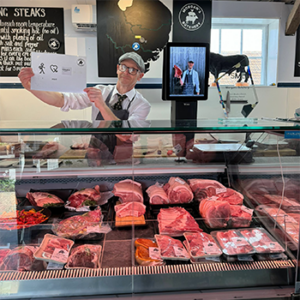 Now, the 59-year-old from Haverhill in Suffolk has not only gone on to own a new butchery, but he and his family used their own experiences of disability to create a barrier-free experience for customers.
This year, they were nominated for a Disability Smart Award for exemplifying what a small organisation can achieve if inclusion is built into its culture from the outset.
The Business Disability Forum’s annual Disability Smart Awards showcase and celebrate the work of organisations that are improving the life experiences of disabled employees and consumers by removing barriers to inclusion.
Morgan’s Butchery was the first retail store to be Makaton aware, creating their own Makaton flashcards (and a system of signs and symbols helpful to people with learning disabilities) as well as their own personalised PECS (Picture Exchange Communication System) cards.
The store offers braille and large print price lists, a portable hearing loop, handrails, slopes outside, and inclusive seating. It is also working on its access guide, which will be available on the website.
Amy Nicholas, co-owner of Morgan’s Butchery and Miles’ daughter, said: “We were so happy to be nominated for a Disability Smart Award, especially when you look at the previous winners and finalists that include Coca-Cola and Tui.
“As a small business, it is lovely to be recognised for trying to make our shop more inclusive for people with disabilities. Hopefully, it will make other businesses realise that it doesn’t cost a lot of money to be disability-friendly. It just requires some out-of-the-box thinking.”
Morgan’s Butchery was first established in 2019 by Matt Morgan, a former student of Miles. After his stroke, Miles didn’t think he had the confidence to go back to managing a team or teaching students. So when Matt asked him to do some consultancy work for a few days a week, he jumped at the chance.
“It worked really well,” says Amy. “But after a couple of years, Matt decided to close the business as he no longer wanted to be a butcher. It was a small shop on a lovely farm site, so we decided to take it over as a family.
“My work has always been working with people with disabilities as a carer, so I have seen firsthand some of the barriers that they face. Now my dad was facing all these new barriers that he didn’t know existed because of his aphasia.
“When he is in situations that he knows will be difficult, anxiety can make his speech worse. For example, when he goes to a coffee shop, he can only order a flat white. He doesn’t like a flat white, but it’s the only one he can say, because the names of other coffees are so complicated. We don’t want anyone to feel that sort of anxiety or daunted when they come into our shop, so we tried to eliminate these barriers as much as possible.
“We hope that other larger businesses will follow suit and become more disability-friendly. It doesn’t take much to make sure that everyone, regardless of their abilities, feels valued and included.”



