Learning Disability Today
Blue Sky Offices Shoreham
25 Cecil Pashley Way
Shoreham-by-Sea
West Sussex
BN43 5FF
United Kingdom
T: 01273 434943
Contacts
Alison Bloomer
Managing Editor
[email protected]
[email protected]

Samir El-Ziftawy, a campaigner for people with profound and multiple learning disabilities (PLMD), passed away peacefully at home in September last year, surrounded by those who loved him. His end-of-life experience shows what is possible when social care and health professionals work in genuine partnership with families: a “good death” where the person’s wishes, comfort, and dignity are at the centre.
I had the privilege of supporting Samir El-Ziftawy for 22 years at our home in Brighton and Hove. Samir was a remarkable man: brave, loving, charismatic, and sociable. Samir was a true inspiration to all who knew him, thanks to his zest for life and determination to create positive change for people like himself with PLMD.
His story shows the power of good support in helping somebody not just to have a good, dignified life, but also a good, dignified end of life. For Samir, when the time sadly came last year after he became unwell, that meant being at home, surrounded by people he loved and who loved him. It meant having people to advocate for him, ensuring that every decision reflected his voice and his wishes. It meant honouring his power to choose, even in his final moments.
Samir fought for these values throughout his life as a significant member of Campaign 4 Change, a self-advocacy group supported by Achieve together. He worked with PMLD LINK to push for greater visibility for people with profound disabilities, and his contribution to a research project related to the role of Acute Liaison Nurses was very much appreciated by Changing Our Lives Charity. In 2025, he was posthumously awarded The People’s Award at the National Learning Disability and Autism Awards.
Now, together with his family, we at Achieve together are committed to ensuring that Samir’s legacy continues by breaking taboos and misunderstandings and sharing our approach to the care and support that helped Samir have a dignified, peaceful death.
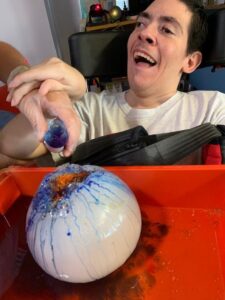 For Samir, being at home in his final weeks meant he could remain in a comfortable setting he was familiar with, surrounded by people who understood his needs and routines. This familiar environment helped to reduce anxiety, made communication easier, and allowed him to spend meaningful time with family and friends.
It isn’t a given that people can be supported with palliative care at home. Making this possible required early planning and close cooperation between Samir’s family, support team, healthcare professionals, and the hospice team at Martlets, who were just incredible. Everyone involved worked together to ensure his complex health needs could be safely managed at home, with the right equipment, pain and symptom control, and emotional support in place. We knew that this was important to Samir, and I feel proud to have played even a small part in making it possible.
Samir’s end-of-life journey was made possible by a remarkable circle of support: our nurse-led team at Achieve together worked with Samir’s family, friends and Campaign 4 Change colleagues, his GP, a Learning Disability Liaison Nurse, the acute hospital trust, Martlets Hospice at Home, physiotherapy, and the local community learning disability team. Some of us had known Samir for decades, some only a few weeks, but everyone worked together in true partnership.
Together, we held regular multi-disciplinary meetings and worked to provide emotional and practical support that helped Samir move from hospital to home when it mattered most. There were difficult decisions to be made at points, and Samir’s sister Yasmin has shared how supported her and her family felt, knowing that every person in the circle of support was advocating for Samir and prioritising his experience and wishes.
There is, unfortunately, still a taboo about speaking openly about death, and too often people with learning disabilities are not included in conversations which are about them. Usually, people are not told when they are dying, out of a misplaced desire to protect them. Samir’s story challenges this – through clear communication and inclusive practices, we were able to ensure that he could engage with his end-of-life planning in ways that were accessible and meaningful to him.
This is really important to us at Achieve together. Across our homes, we use clear, tailored communication and resources, such as Books Beyond Words, to ensure that those we support can make informed choices – some of the most important decisions in a person’s life. We also work with people’s friends, peers, and team members to understand what is happening, so that they, too, can prepare, say goodbye, and feel included.
A good death is not just about the person who is dying; it is also about the people who are with them. It’s about the people around them feeling equipped, confident, and supported to provide the best possible care for someone towards the end of their life. By ensuring our teams felt confident and supported, we knew that they could offer the compassionate, skilled support Samir and his family needed in emotionally challenging circumstances.
We ensured that our team had regular check-ins, debriefs, and guidance from both our internal nursing and clinical teams, as well as the Martlet’s hospice team. Together, we discussed what to expect, managed anxieties, and provided emotional support to those who supported Samir and his family. We fully appreciate the depth and quality of the relationship our team members built with Samir, the love for him they felt and the impact his inevitable death would have on individuals and the team as a whole.
Samir’s life and death have already influenced thinking in terms of Palliative Care for people with learning disabilities. Yasmin, Erren Wheatland (Head of Health, Achieve together), and I presented his story at a recent national conference hosted by the Palliative Care for People with Learning Disabilities (PCPLD) Network. Yasmin and I want to make sure that his story continues to inspire change and strong partnership working at the end of life.
We know that people with profound learning disabilities face stark health inequalities, often dying younger and with less access to appropriate end-of-life care. By sharing stories like Samir’s, we can challenge this and push for a future where dignity, choice, and peace are non-negotiable.
Laurie Hopper, Registered Manager for 287 Dyke Road Residential Home, at Achieve together


