Learning Disability Today
Blue Sky Offices Shoreham
25 Cecil Pashley Way
Shoreham-by-Sea
West Sussex
BN43 5FF
United Kingdom
T: 01273 434943
Contacts
Alison Bloomer
Managing Editor
[email protected]
[email protected]

Trigger warning: drowning and water safety.
Autism, wandering and drowning have been described as the deadly triad that destroys lives. This article examines efforts to improve swimming skills and water safety among children with neurodevelopmental disorders.
Research suggests that drowning is one of the leading causes of death among autistic people, making water safety critical, especially as many autistic people are drawn to water and some are unable to understand the associated dangers.
It is the leading cause of death in autistic children under the age of 14, accounting for 91% of childhood deaths in this population, with a 2017 study by Columbia University’s Mailman School of Public Health suggesting that autistic children were 160 times more likely to die from drowning than the general population.
It prompted Professor Guohua Li, a senior author of the study, to suggest that swimming lessons for autistic children should be the number-one priority for families.
He said: “Once a child is diagnosed with autism, usually between two years and three years of age, paediatricians and parents should immediately help enrol the child in swimming classes, before any behavioural therapy, speech therapy, or occupational therapy. Swimming ability for kids with autism is an imperative survival skill.”
Wandering is a common behaviour in autism, and many children with the condition have an affinity with water. For autistic children with an impaired perception of its dangers, water can appear to offer an oasis of tranquillity and calm away from the urgency of their anxiety or sensory difficulties.
In the most recent tragic example in the UK, seven-year-old Nyla May Bradshaw was taken to a park in Owston, Doncaster, on March 30, and reported missing a short time later.
Nyla, who had autism and could not speak, had passed through a hole in a fence and walked towards nearby woodland. The child was later found face down in a pond in the grounds of Owston Hall Hotel before being pronounced dead at Doncaster Royal Infirmary.
In the aftermath of Nyla’s death, autism researcher Dr Paul Whiteley called for greater awareness of the deadly triad that is “autism, wandering/elopement and drowning.”
In a post on LinkedIn, he said these kinds of news reports appear far too often and they “expose not only gaps in our appreciation that some autisms are truly life-limiting disorders, but also that ‘autism awareness’ does not seemingly – at least here in the UK – yet include a thorough appreciation of the risks associated with issues like lacking danger awareness and being prone to either bolting or eloping that many people with autism face.”
He added that more is needed to draw attention to this deadly issue and push the ‘check water first’ message for first responders and others. Also, it was a message that should be on every school wall, every doctor’s surgery, every respite centre, every social and community venue, every shopping mall, every religious venue, everywhere.
Swimming instructor Richard Wilson has spent more than 25 years teaching children how to stay safe in the water and specialises in working with people with disabilities. He has no doubt about the enormous benefits of learning to swim for disabled children.
“It’s a life skill that is an absolute necessity for all children, but especially for children with any learning difficulties, any physical disabilities. It’s massively important for them to be safe in and around water.”
Wilson is an instructor with Swimtime and organises lessons at venues like Village Hotels, Everlast Gyms and Holiday Inns. He says lessons for children with disabilities are essentially the same as for those without neurodevelopmental challenges — but adapted around their needs.
Wilson maintains that the benefits extend beyond simply becoming safer in the water to include nurturing a developing and growing confidence outside the pool.
He added, “It might mean that they use more visual cues to be able to understand what we’re trying to achieve. One of the first ever children I taught — he had cerebral palsy and was in a wheelchair. And the freedom that he got from having the movement in the water and not being either laid down in bed or sat up in a wheelchair was transformational for him.”
Ben Aston’s relationship with water has been life-changing. Mum Helen says even as an infant, her now 25-year-old son was a natural water baby. He had learnt to swim by around age seven, and when Ben, who has Down syndrome, left school, his mum searched for something that would give her son renewed purpose.
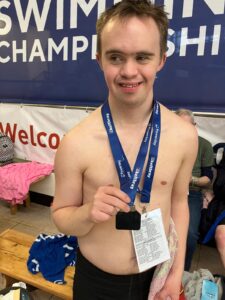
Now he is a medal-winning swimmer who has won two golds, three silvers and a bronze at the British Down Syndrome Swimming Championships since 2023.
Ben, who developed his skills at Swimtime, the UK’s largest independent swimming school, wants to take part in the British Special Olympics next year. He said being in the water makes him feel “happy, relaxed and calm” and winning leaves him feeling “excited” and he wants to carry off “all the trophies”.
Helen added that in recent years Ben has been disqualified from breaststroke events at the swimming championships due to difficulties with his strokes. But he has shown huge commitment to improve in this event, she added.
“Last year, he was so determined and focused that he was not going to get disqualified, and he didn’t. That mental ability to focus on something is so good for him, and it has given him, I think, more confidence outside of sport in that he can talk to somebody about it,” said Helen.
Richard Wilson, however, believes that national trends over swimming pool closures are damaging the prospects for all children to learn to swim. Wilson accused the government of failing to put in the “funding and backing to keep swimming pools open”.
Industry bodies Swim England and ukactive say that since 2010, over 500 public pools have closed, and closures are accelerating, with 76% closing since 2020. Around 70% of children left primary school in 2023/24 able to swim confidently for at least 25 metres in line with the national curriculum, according to Sport England. This is a drop from 77% in 2017/18.
Last year, sports minister Stephanie Peacock told parliament that 254 new pools have opened since 2015, mitigating some of the impact of the closures.
A spokesperson for the Local Government Association, which represents the councils that operate many pools, pleaded for cash for sports facilities.
They said, “Local communities rely on sport and leisure facilities every day, whether it is swimming for the family or going to the gym. The benefits to both physical and mental health can be life-changing, and we know that swimming is particularly important for those with a disability or long-term mental health condition. Without urgent investment, we risk losing these altogether.”
A government spokesperson said they have committed £400m to transforming sports facilities over the next four years.
“Swimming and water safety are fundamental, compulsory elements of the national PE curriculum at key stage one or two, and we are committed to supporting schools to provide opportunities for every pupil to learn to swim,” added the spokesperson.
Autism Speaks – water safety
National Autism Association – water safety and drowning prevention


