Learning Disability Today
Blue Sky Offices Shoreham
25 Cecil Pashley Way
Shoreham-by-Sea
West Sussex
BN43 5FF
United Kingdom
T: 01273 434943
Contacts
Alison Bloomer
Managing Editor
[email protected]
[email protected]

The staff vacancy rate in the adult social care sector remains around three times that of the broader economy, highlighting ongoing long-term recruitment and retention challenges.
The latest Skills for Care data also shows that the sector is projected to need around 470,000 new posts—an increase of 27%—by 2040 to keep up with the projected growth in the population over the age of 65.
However, the annual ‘State of the adult social care sector and workforce in England’ report did find that the industry is growing, with the total number of posts in adult social care increasing by 2.2% on the previous year.
Its economic contribution also increased by 12.2% to reach £77.8 billion. This is driven mainly by more filled posts in social care and an increase in the National Living Wage, which has led to higher average pay.
Vacancy rates have also returned to pre-Covid levels at 7% and the proportion of men in the workforce reached a new record for the third successive year, now at 22%.
The number of filled posts grew by 3.4% to 1.6 million. This growth was smaller than the previous year, but still the second-highest increase on record. The improvements in workforce capacity continue to be supported by international recruitment, but the number of recruits fell from 105,000 in 2023/24 to 50,000 in 2024/25.
In July 2025, changes to immigration rules meant care workers and senior care workers were
removed from the Health and Care Worker visa route for new overseas recruits. These changes to immigration policy have caused large changes in the number of people recruited internationally over the period, which has also impacted the vacancy rate.
Over the same period, the number of workers with British nationality declined by 30,000 (a 2.6% decrease). The report said that this lack of growth in domestic recruitment highlights the need to build a more sustainable, long-term workforce.
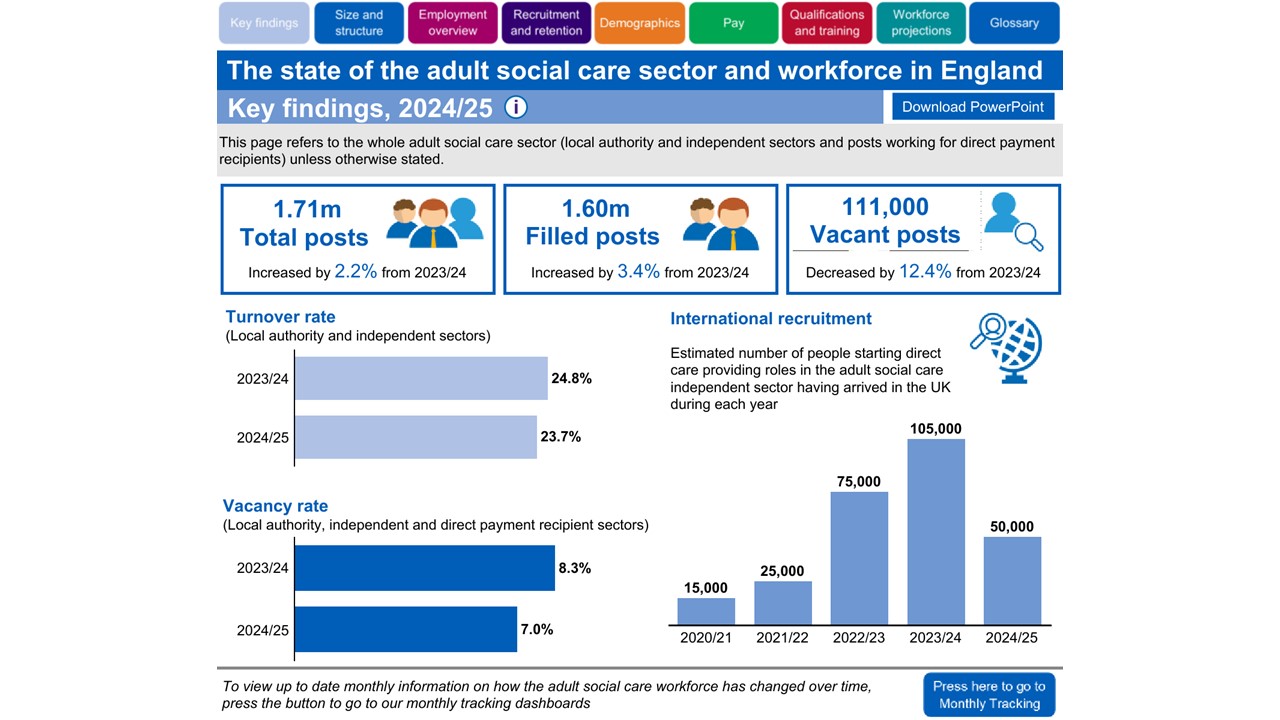
The turnover rate in the independent sector decreased from 25.8% in 2023/24 to 24.7% in 2024/25.
The five factors contributing to staff turnover, according to the report, are pay up to 30% below the local authority average, not being on a zero-hours contract, receiving training, having a qualification relevant to social care, and working full-time.
People with none of these factors in place are almost three times more likely to leave their jobs compared to people with all five factors (42.2% vs 14.4%).
For the first time, the report includes figures on employer sick pay and pension contributions, which show that 62% of care providing establishments using the Adult Social Care Workforce Data Set (ASC-WDS) don’t offer enhanced sick pay, and 57% don’t offer enhanced employer pension contributions (more than 3%).
The proportion of care and support workers with a Level 2 qualification has fallen to 38%—down from 41% in 2023/24 and 48% in 2018/19.
Professor Oonagh Smyth, Skills for Care’s CEO, said that to meet growing and changing care needs, the sector must prioritise domestic recruitment and invest in learning and development for our workforce.
She added: “Our latest report highlights the complex nature of the social care sector today, with encouraging signs of progress for our workforce, alongside challenges that still need to be addressed. It’s positive to see our workforce growing, and vacancy and turnover rates continuing to fall. However, much of this improvement is being driven by international recruitment and, as both domestic and international recruitment are slowing, we need to explore new pathways to build sustainable workforce capacity.
“At the same time, falling qualification levels – when care roles are becoming more complex – suggest that capability, as well as capacity, is likely to be a challenge in the future. We have to ensure that people have the skills, values and confidence to do these essential roles in social care.”
The ‘State of the adult social care sector and workforce report’ uses information on more than 700,000 staff in over 21,000 locations.
A Department of Health and Social Care spokesperson said: “It is welcome to see the continued improvement in retention – with vacancy rates now the lowest since the pandemic, and staff turnover at its lowest in almost a decade. With the government’s increase in the minimum wage and the introduction of the living wage, we are putting money in the pockets of some of the most deserving people in our society: care workers.
“As the Secretary of State announced last month, we are establishing the first ever Fair Pay Agreement, backed by £500 million, to further improve the terms, conditions, and pay of care workers, and to help them stay and progress in the social care sector..
“Baroness Casey’s Independent Commission into adult social care will publish recommendations next year for building a National Care Service that is fair and affordable for all.”
Jon Sparkes OBE, Chief Executive of Mencap, said: “As this report shows, the more social care worker posts are filled, the more the economy benefits.
“Yet, as our domestic workforce is declining, the Government has barred social care providers from recruiting overseas care workers and made it more difficult for those already here to continue working. Plans to fix recruitment and retention in the sector are years off, so what is the Government doing now to avoid the cliff edge we’re facing?
“With 111,000 care worker vacancies, it’s extremely worrying to cut off a key source of talent without a workable alternative. People with complex needs will be left without the care they rely on, families will be pushed to breaking point, and the risk of serious harm will rise. Lives will be at risk if the sector is allowed to unravel.”
Rachael Dodgson, Chief Executive of Dimensions, said: “The drop in social care vacancies shown in Skills for Care’s annual report is encouraging – and surprising. The near-halving in workers recruited from overseas is anticipated, given the tightening of immigration rules. The fact this coincides with a 2.6% decline in workers of British nationality is concerning. The government needs to make careers in care and support more attractive to all.
“Pay is central. While we welcome the Fair Pay Agreement, it will not take effect until 2028. Social care can’t wait that long. The government has pledged £500 million to fund this agreement in the first instance. Spread across 1.5 million care workers, £500 million is only approximately 20 pence more per hour, according to the Health Foundation.
“Clearly, this £500 million falls far short of what is required to recruit and retain sufficient care and support workers. We will keep doing all we can as a provider, but government action is long overdue.”
Kathryn Marsden OBE, Chief Executive of SCIE, said: “Despite some good news about the care workforce in this report, we shouldn’t be complacent. The workforce has grown for the third consecutive year, and average vacancy and turnover rates have continued to fall. However, a detailed look at the underlying workforce pressures suggests breathing easy would be premature. A relentless focus on improving care workers’ pay, working conditions and career opportunities remains critical to stabilising the social care system.
“One driver of the workforce trends is international recruitment, but we cannot rely on international workers for the long term. As the report describes, the domestic workforce is still shrinking, and routes for international recruitment are being sealed off, reducing the pool of people available to work in the sector. Renewed attention to recruiting a home-grown workforce is urgently needed.
“Of great concern is that workers’ pay has not kept pace with increasing experience. The report highlights that care workers with five or more years of experience are only earning 7p more per hour than new starters. A recognised career path that recognises workers’ experience with better pay is sorely needed.
“Equally as concerning is the decline in workforce qualification levels, which raises questions about the sector’s capability for meeting the people’s social care needs. Increasingly, care workers require skills for delegated health tasks and caring for people with complex conditions. Investing in training and skills development must remain a top priority for all care employers, along with a pay structure that rewards increasing skills.
“The workforce is our sector’s beating heart. Every day, those working in care go above and beyond to provide the support that transforms lives, enabling people to live with greater independence, dignity and purpose. Their work sustains families and communities, eases pressure on our other public services and, as this report evidences, contributes £77.8 billion each year to the wider economy—more than the accommodation and food service industry.”



