Learning Disability Today
Blue Sky Offices Shoreham
25 Cecil Pashley Way
Shoreham-by-Sea
West Sussex
BN43 5FF
United Kingdom
T: 01273 434943
Contacts
Alison Bloomer
Managing Editor
[email protected]
[email protected]

There is growing recognition within social work and education that inclusion is not just about access, it is about participation, voice, and shared learning. At the University of East London, this thinking has been developed through an innovative teaching approach: the RIX Big Ideas course.
This course brings together social work students and people with lived experience of learning disabilities to learn side by side. It forms part of a wider “advocacy pathway” within the Readiness for Practice module, where students develop skills in communication, relationship-building, and person-centred practice.
Traditionally, this pathway involved students working in community settings, building relationships over time. While this continues, a new classroom-based approach has been introduced. In this model, people with lived experience join the university as students, taking part in structured sessions alongside social work students.1
In the 2025–2026 academic year, 11 students with learning disabilities and 11 social work students took part. Together, they formed a co-learning group that met weekly over several months. The aim was simple but ambitious: to create a space where everyone could learn, contribute, and engage with ideas that shape how disability is understood.
The course builds on an international project called Big Ideas that Changed the World of Disability.2 This project showed that people with learning disabilities can engage with complex theories when these are presented in accessible ways and connected to real-life experiences.
This is important because, historically, people with learning disabilities have often been excluded from engaging with theory. They may be involved in research or discussions, but are rarely invited into the ideas that shape policy, practice, and understanding.
The RIX Big Ideas course seeks to change this.
Students explored a range of key ideas about disability and society, including:
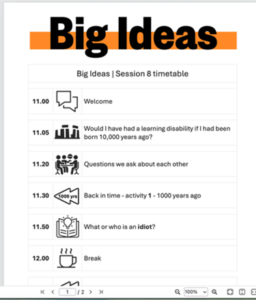
Rather than teaching these ideas in traditional lecture formats, the course focused on making them meaningful and accessible.
A key part of the course was the use of Universal Design for Learning (UDL). This approach recognises that people learn in different ways and that teaching should reflect this from the start.3
Each session included:
Importantly, students were not expected to engage only through writing or speaking. Instead, they could use a range of formats to explore and express ideas. This is where multimedia advocacy played a central role.
Multimedia advocacy is an approach developed by RIX that supports people in communicating through different media, such as images, video, audio, and text.4,5

In the course, students used tools like Rix Wiki to:
For example, one student might explain a theory through a short video, while another might use images or simple text.
This approach recognises that communication is not one-size-fits-all. It also shifts how we think about knowledge. Instead of seeing knowledge as something written in essays or textbooks, it becomes something that can be created and shared in many different forms.

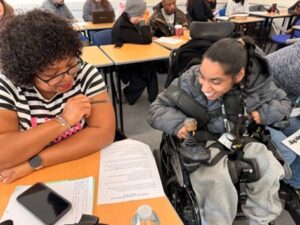
One of the most important aspects of the course was learning together. Students worked in pairs or small groups, mixing social work students with students who have lived experience. These groups changed regularly, giving everyone the chance to work with different people.
This supported:
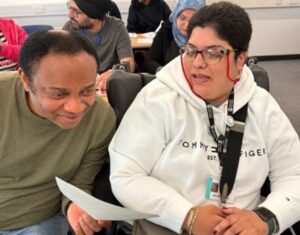
For social work students, this was especially valuable. It gave them direct experience of working in partnership, something that is central to good social work practice. Rather than learning about inclusion, they were learning through inclusion.
For students with lived experience, the course provided meaningful access to higher education. It also created space to engage with ideas that often affect their lives, but which they may not usually have access to. At the same time, this kind of learning requires careful support. Facilitators need to ensure that everyone can take part in ways that feel comfortable and meaningful, and that no one feels overwhelmed or excluded.
One of the challenges of the course was making complex ideas accessible without losing their meaning. To address this, sessions combined theory with practical activities. For example:
This helped students connect theory to real life. However, it also raised important questions. How do we simplify ideas without oversimplifying them? How do we keep the depth of theory while making it accessible? These are ongoing challenges, and part of the learning for both students and staff.
While formal evaluation is still ongoing, there are some early insights. For students with learning disabilities, the course created opportunities to:
For social work students, it supported:
For the group as a whole, the course created a shared learning space where:
These outcomes reflect wider research showing that inclusive approaches can benefit all learners, not just those with identified support needs.
 While the course has shown positive potential, it is not without challenges. Inclusive, co-produced learning takes:
It may also sit uneasily within university systems that are built around standardised teaching and assessment. There are also ongoing questions about:
These challenges highlight that inclusion is not just about individual courses; it requires broader changes in how education is structured.
The RIX Big Ideas course offers one example of how teaching and learning can be rethought to be more inclusive, participatory, and meaningful. At its heart, the course is about shifting how we understand knowledge and learning:
It shows that engaging with theory is not just for some people. It is something that everyone can be part of when the right support and approaches are in place. We have secured funding for an independent evaluation of the course, and we look forward to learning more about its impact in the coming months. As we continue to develop this work, we are also inviting new participants to join the next course.
Registration is now open, and places are limited. If you are interested, please email [email protected]
Gosia Kwiatkowska, Associate Professor, Director, Rix Inclusive Research Institute, University of East London.
Contact: [email protected]


