Learning Disability Today
Blue Sky Offices Shoreham
25 Cecil Pashley Way
Shoreham-by-Sea
West Sussex
BN43 5FF
United Kingdom
T: 01273 434943
Contacts
Alison Bloomer
Managing Editor
[email protected]
[email protected]

When Labour took office a year ago, there was a feeling of relief among disability campaigners that a new government brought the promise of change. In the field of disability and SEND, change was very much needed.
It all started so well with a King’s Speech packed with policies that promised to modernise the Mental Health Act, deliver a Fair Pay Agreement in the adult social care sector, and a Children’s Wellbeing Bill that would put children at the centre of education and “make changes so they are safe, healthy, happy and treated fairly.”
However, a raft of money-saving decisions ensued that put Labour at odds with the electorate at every turn. Most recently, their flagship welfare bill was condemned as cruel and dangerous by many, including a significant number of Labour backbenchers, and forced the government into an embarrassing, but necessary, U-turn.
Now, all eyes turn to the next ‘austerity measure’ disguised as a benevolent reform: the September schools white paper. With growing rumours of plans to strip legal rights away from children with special educational needs and disabilities (SEND), it seems the year-old promise to treat children “fairly” is about to fall into the same black hole as the £5 billion the government hoped to slash from disability costs.
It has been nearly a week since the Save Our Children’s Rights (SOCR) group launched its campaign to protect the legal rights of children with SEND. The launch was supported by a letter in The Guardian, signed by over a hundred disability organisations, campaigners, academics, and celebrities.
The letter stated that, as new education reforms loom, every sign from the government suggests that the right to an Education, Health and Care Plan (EHCP) is to be removed from children attending mainstream schools.
It added that 85% of children with SEND are educated in mainstream settings, and over 270,000 of these children have EHCPs that detail a child or young person’s needs and the support to enable them to fulfil their potential.
Since the publication of the letter, debate has raged all week about what the future of SEND support should look like in England. Here is a roundup of some of the arguments for and against.
Like many media outlets this week, Learning Disability Today directly asked the Department for Education (DfE) about its plans for EHCPs. A spokesperson referred to previous statements from the Schools Minister, Catherine McKinnell, that no decisions have yet been taken.
We were also told that the DfE have “been clear that there are no plans to abolish SEND tribunals, or to remove funding or support from children, families and schools.” Yet, parent advocates have been quick to point out that the absence of EHCPs reduces the need for tribunals.
So, with no clear plan from the Government, speculation has been rife on both sides of the argument for retaining EHCPs in mainstream settings.
The biggest show of support for EHCPs this week came from Helen Hayes, Chair of the Commons Education Select Committee, which has just completed a new major inquiry focusing on finding solutions to the crisis in SEND provision.
She said that mistrust among many families with children with SEND was so apparent that ministers should commit to keeping EHCPs.
Speaking on BBC Radio 4, she said: “It is absolutely clear to us on the select committee that we have a system which is broken. It is failing families, and the government will be wanting to look at how that system can be made to work better.
“But I think they have to take this issue of the lack of trust and confidence, the fear that parents have, and the impact that it has on the daily lives of families. This is an everyday lived reality if you are battling a system that is failing your child, and the EHCPs provide statutory certainty for some parents. It isn’t a perfect system … but it does provide important statutory protection and accountability.”
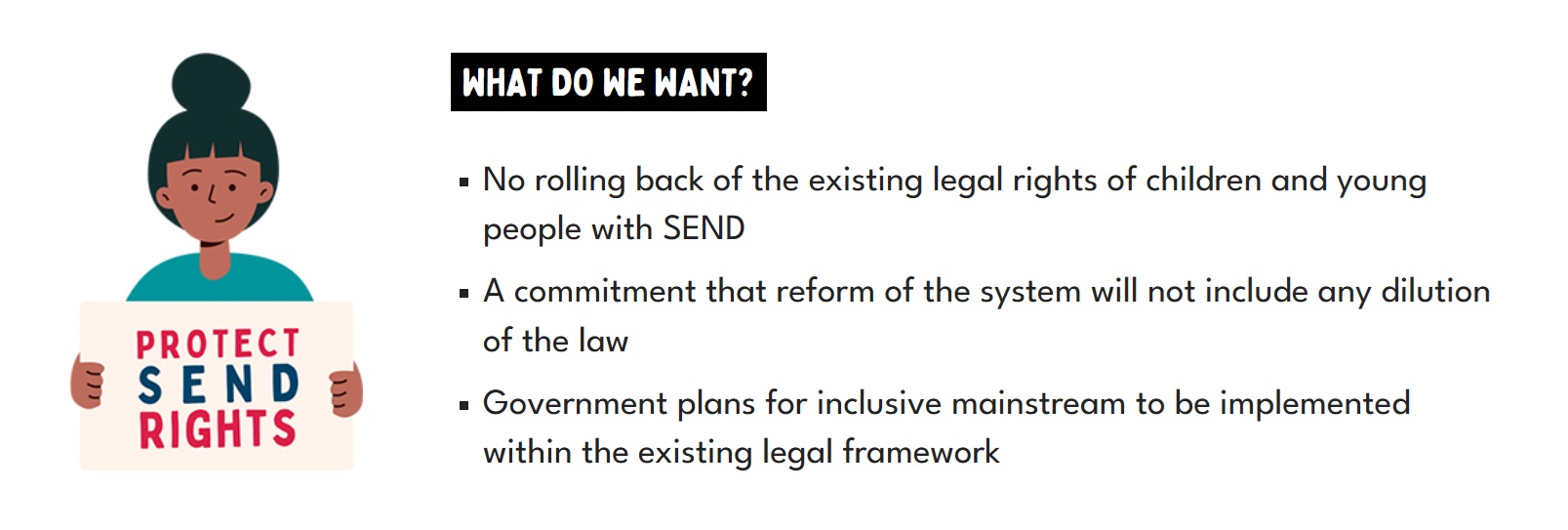
So, if it is not a perfect system, why are so many people, including the SOCR group, campaigning to save it?
Tania Tirraoro, founder of Special Needs Jungle and fellow SOCR campaign member, answered this question excellently in an editorial in Schools Week. She said: “The answer is simple. It is not the law that is at fault; it is how the last set of reforms in 2014 was implemented and funded that has failed.
“It is not the law that has consistently underfunded education as a whole, and schools’ SEND budgets in particular.
“It is not the law that has designed a curriculum that creates barriers for many neurodivergent children.”
Another person who cut through the noise was disability and children’s rights advocate Steve Broach, who asked on X what part of the EHCP process Ministers think we don’t need. Was it where we identify all the child’s special educational needs, we specify the provision reasonably required to meet those needs, or where the child gets the right to attend a suitable school?
One of the most frequently cited arguments in the media this week, from a wide range of spokespeople, is that removing EHCPs from mainstream schools would save money. They say that a surge in the number of children getting EHCPs (currently 638,745) has resulted in local authorities accumulating large, unsustainable deficits.
Many cited a report from the National Audit Office, which found that, despite the increase in funding, the system is ‘still not delivering better outcomes for children and young people’.
An Institute for Fiscal Studies report, published last year, was also used as evidence that ‘meaningful reform’ was essential for the SEND system. It found that without reform, rises in need will push up annual spending by at least £2–3 billion in the next three years.
It said that reform should include expanding the core SEND provision to be available in mainstream schools and state-funded special school places, redistributing funding so it is more evenly spread across the country, and reducing the statutory obligations currently attached to EHCPs.
There was also the usual ramblings in the press of parents abusing the system for free taxis to school, and the “obsession with neurodivergency” backfiring on those most in need. One columnist in The Telegraph suggested a “shocking dose of reality that Ukrainians or Israelis are experiencing” might help us find a solution to “a culture of entitlement and welfare dependency.”
These interesting views aside, much of the argument for scrapping EHCPs is financially driven. However, as the campaign group SOCR points out, what is largely overlooked in these arguments is that a vast investment would be needed to achieve effective inclusion in mainstream schools.
And if children and young people are no longer legally entitled to the help they need, what will happen when the support they need fails to materialise?
This was a concern raised by the Public Accounts Committee (PAC) last year, which found that a significant problem was that the DfE does not fully understand why the demand for SEND support has increased. It was also unclear what inclusive education means, a core strand of its approach, and how it will be achieved.
It added that “every day that goes by for families not receiving the right support is another day closer to a lost generation of young people.”
This was confirmed in a new analysis released today by The Who is Losing Learning Coalition, comprising IPPR, The Difference, Impetus, and Mission 44, which analysed Department for Education data on suspensions and permanent exclusions in England. The analysis found that half of all children suspended from school have special educational needs (SEN).
The analysis also showed that £1.9 billion will be lost to the Exchequer for last year’s excluded cohort. When children are told to leave their school permanently, they go on to cost the state £170,000 over a lifetime in reduced earnings, welfare use, and criminal justice costs.
That’s the crux of it. Instead of viewing the rise of EHCPs as a need to number crunch and cost save, perhaps we see it as the system moving in the right direction, with every penny of these legal documents being a crucial investment in the next generation. By providing a scaffold of support to those pupils who need some adjustments to learn and prosper, surely this must be good news for the future economy.
As we await the details of the new white paper in the autumn and the results of the Education Committee’s inquiry into ‘solving the SEND crisis’, perhaps the real question as we look ahead is the one asked in the SOCR open letter.
And that is, as a country, whatever the SEND system’s problems, can we afford not to keep the precious legal protections of children and young people?
The SOCR campaign is led by a coalition of organisations and individuals, including Special Needs Jungle, IPSEA, Learning Disability Today, SEND National Crisis, SOS!SEN, SEND Rights Alliance and others who are committed to defending children’s rights.



